
When space and demand drift out of sync, everyone feels it. In 2025, portfolio optimization finally surpassed cost reduction as the top priority for CRE leaders, according to JLL. Driven in part by evolving hybrid work policies and return-to-office mandates, this shift in focus requires organizations to take a different approach to the relationship between their real estate assets, people, and business needs.
And many are working with processes strictly built for cost cutting. Their portfolio management systems, tools, and habits that grew out of a cost-reduction mindset haven’t adapted to support the diverse and rapidly changing needs of modern real estate portfolios.
That’s why we put together the CRE Alignment Checklist. By working through these eight checks, enterprises and other office-based organizations can see what’s working and what needs a tune-up.
The CRE Alignment Checklist
Most of the alignment issues between an organization’s portfolio assets, goals, and people stem from mistaken assumptions, location decisions made without portfolio-level context, and process problems that create delays. It’s important to get this right, because buildings aren’t passive – they shape behavior. But pinpointing the real cause isn’t easy. This list helps you do just that.
Whether you go through the CRE Alignment Checklist proactively or as a way to diagnose felt alignment issues, each of the eight items in this list represents an area that organizations tend to overlook:
- Average peak utilization analysis
- Non-reservable space tracking
- Portfolio-level scenario testing
- Overlaid view of lease options
- Bad locations repurposed
- Accessible decision-grade data
- Cross-functional visibility
- Manual processes eliminated
1. Average peak utilization analysis
Check: Our organization tracks and analyzes peak utilization of our space—not just average utilization.
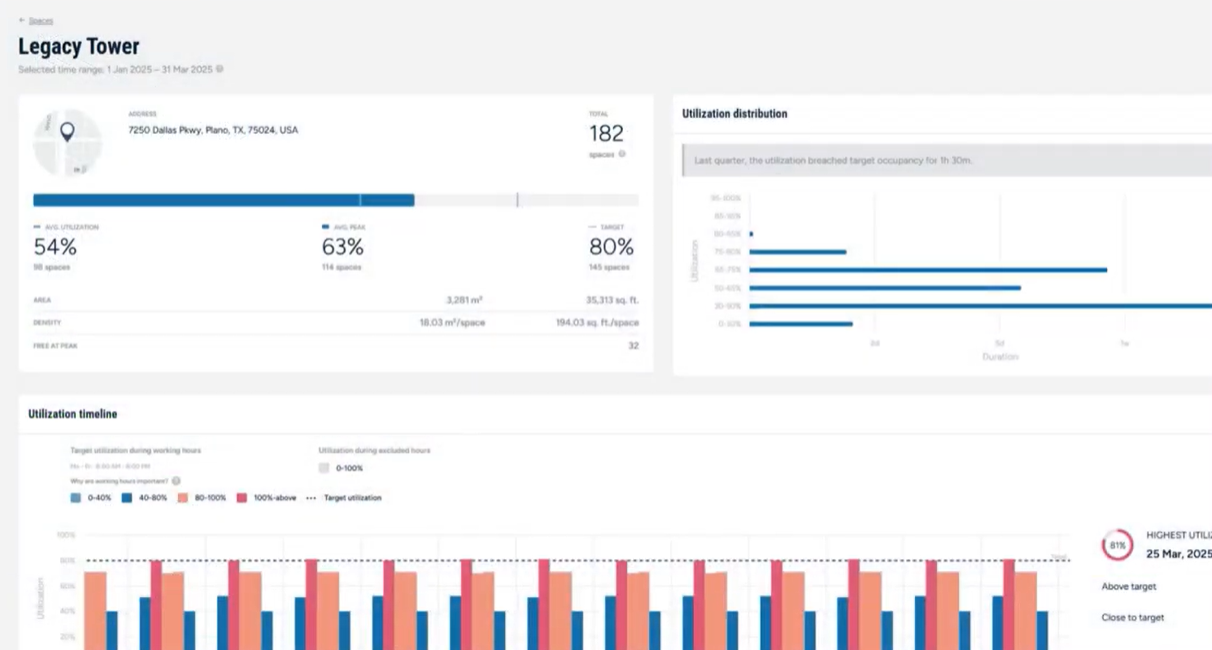
Average utilization is a key metric most companies use to assess whether a location has excess space. If it’s not being utilized, why pay for it? But this approach is also shortsighted, and often creates misalignment between the space you have and the space you need.
Behind that average are peaks and valleys in demand that reflect variable needs. Cut too much space, and you can no longer support your people on your busiest days. Cut too little, and you’re still paying for space you don’t need.
Average peak utilization shows you how much space a location typically needs on its busiest days. Your highest peaks may represent one-off usage from unusual circumstances, where you (and your people) may be more willing to accept a lack of space. But your average peak utilization reflects a more regular occurrence—especially in a hybrid workplace, where demand for space is harder to evenly distribute.
Similarly, average valleys in utilization can be helpful in deciding whether a location may actually need less space than average utilization would seem to suggest. A major gap between average utilization and average dips in utilization could indicate that redistributing demand (perhaps through modifying hybrid work schedules) would allow you to reduce your space even further to improve alignment between your assets, people, and goals.
2. Non-reservable space tracking
Check: Our organization tracks the utilization of non-reservable space (including permanently assigned areas) and incorporates this data in real estate decisions.
Our 2025 Enterprise Occupancy Tracking Report found that most enterprises track occupancy (and thus space utilization) using a badge scanning system (76%), desk booking software (68%), or both (56%). Just 29% of firms we surveyed used occupancy sensors, and only 4% used network-based occupancy monitoring.
This means most companies can’t really see how their non-reservable space is being utilized. While you may be able to generally evaluate whether you have enough desks, meeting rooms, and reservable resources, you can’t make the same data-based determinations about non-reservable space, or even permanently assigned space.
Informal meeting areas, workspaces, kitchens, lounges, amenities, and other spaces are essential parts of the workplace. If they become congested or over-utilized, this too can inhibit productivity and negatively impact employee experience.
To fully align your real estate, people, and business goals, your real estate decisions need to include utilization data from these non-reservable spaces. In most cases, that means installing space utilization sensors or activating a sensorless occupancy monitoring system.
3. Portfolio-level scenario testing
Check: Our organization forecasts how policy changes, initiatives, and how space supports people and business needs will likely impact the entire portfolio.
It’s hard to predict how proposed policy changes, goals, or real estate initiatives will affect the actual locations within your portfolio. The scope is too big for traditional space management solutions, personal experience, or internal tools to accurately forecast.
How will changing in-office requirements impact overall utilization in the portfolio and each location? How will planned relocations and consolidations affect turnover, based on employee commutes? If you need to find 200 desks to make room for growth, where is there already sufficient space in your portfolio?
The answers to these questions require portfolio-level visibility into a wide range of data from across your business. And these are exactly the kinds of questions Tango Portfolio Strategy was built to answer.
However you do it, portfolio-level scenario testing is a must to ensure that major organizational changes don’t knock your assets, people, and goals out of alignment.
4. Overlaid view of lease options
Check: Our organization explores all lease options (renewals, break options, etc.) in a single view to see the full range of opportunities.
In a large portfolio, you may have dozens or even hundreds of locations coming up for renewal every year. Beyond that, you may have break options, subletting approval windows, expansion and contraction clauses, and other opportunities arising as well.
But if you don’t examine your options together, overlaying different types of opportunities in a single view, you often miss ways to improve CRE alignment.
Perhaps there’s a poorly utilized location that you’d like to close—let’s call it Location A. But it’s not up for renewal for a few more years. To improve your overall utilization, you choose not to renew a nearby location that was a better fit for your portfolio—Location B—and consolidate it with Location A. Sometime after the decision is made, you review other lease opportunities and discover that you could’ve just exercised a break option or contraction clause for Location A.
Overlaying all your lease options in one view makes these avoidable tradeoffs less likely to occur, because it’s easier to find alternative solutions within your portfolio. But if you’re using spreadsheets or internal tools, it can be hard to build and maintain this visibility. Modern lease software like Tango Lease, however, can provide comprehensive views of your lease options in standard dashboards.
5. Bad locations repurposed
Check: Our organization considers alternative ways for underperforming or poorly utilized locations to serve the portfolio before exiting the lease or opting not to renew.
In the previous scenario, being stuck with the poorly utilized location was an undesirable outcome. But sometimes keeping a location that looks “bad” on paper can actually serve to improve your CRE alignment.
For example, suppose a poorly utilized location has unusually low costs, especially compared to other nearby locations. That could make it a prime candidate for consolidating multiple locations. Even though at first glance it may appear to be a significant waste of space, repurposing this location could prove to be a better strategic option than exiting the lease or not renewing.
Repurposing undesirable locations requires you to look deeper than the individual location and consider your broader goals for the portfolio as a whole and/or what will best serve employees. Doing that regularly will help you strengthen alignment between your assets, goals, and people.
6. Accessible decision-grade data
Check: Our organization’s CRE decision-makers have convenient access to all the lease, finance, maintenance, and energy data they need to make the right decisions fast.
When speed is the priority, details get lost. It can take a lot of digging to find the insights you need to align your assets, people, and goals. It’s easier (and often much faster) to lean on experience or let leadership’s preferences guide your decisions.
Location decisions are often made with insufficient data in order to avoid delays and lost opportunities. But the tradeoff means greater risk. More potential for misalignment. And frequently, the cost of having to rework or resolve poor decisions down the road. Good data helps you see what’s working for people – and what isn’t.
By making decision-grade data readily available to stakeholders, you can make accurate, confident decisions without losing momentum.
AI will undoubtedly improve the accessibility of real estate data in the coming years, but for many businesses, the first step is simply getting the right (and current) information in configurable dashboards and dedicated solutions, where CRE leaders can filter and analyze it as needed.
7. Cross-functional visibility
Check: Our organization can examine data from a wide range of LOBs, roles, and processes in a single system.
For some, the challenge with aligning CRE assets with employee needs and business goals isn’t necessarily that the data they need isn’t available. It’s just too scattered. Lease, space, finance, and portfolio data is spread across multiple lines of business, roles, spreadsheets, tools, versions, and channels. So, understandably, you’re often stuck working from an incomplete picture of your business needs and strategic options.
On the most basic level, the solution is to have intuitive integrations between relevant tools and datasets to ensure everything appears in portfolio workflows. Ideally, you should have a comprehensive platform—an IWMS—to keep it all together and current in one definitive source of truth.
In the near future, however, we expect that leading IWMS vendors will include centralized AI assistants to make decision-grade data even more accessible. We’re already working toward this with Ask Tango, an AI-enabled search feature that lets enterprises use natural language and simple questions to navigate portfolio documents and dashboards.
8. Manual processes eliminated
Check: Our organization never experiences delays as a result of manual portfolio management practices. When it comes to portfolio management, we’ve automated everything we can.
Every manual step in your portfolio management decisions—from collecting data to processing approvals, building spreadsheets, creating lease schedules, and handing off documents—carries risk. Each one is a potential delay. A missed opportunity.
Emails can get buried in inboxes. Updates can be neglected. Key information can be missed. And distractions can interfere.
To establish and maintain CRE alignment, you need to automate as many of these manual processes as possible and leave less room for human error to create misalignment. Ad-hoc and general-purpose solutions won’t scale with your portfolio. You need dedicated tools that are purpose-built to streamline portfolio management and provide clear accountability for CRE decisions.
Check every box with Tango
Right now, you may not have all of this covered yet. But each of these items can and should be addressed if you want to align your real estate assets with your goals and people. At Tango, we help office-based organizations improve this alignment by helping them bring people, data, and place together to make more confident, informed decisions.
Enterprises, nonprofits, and government agencies rely on Tango’s IWMS solutions and AI capabilities to track and analyze occupancy data, test scenarios across their portfolios and individual locations, and accelerate lease management processes.
Want to see how Tango can help you get more from your CRE portfolio?