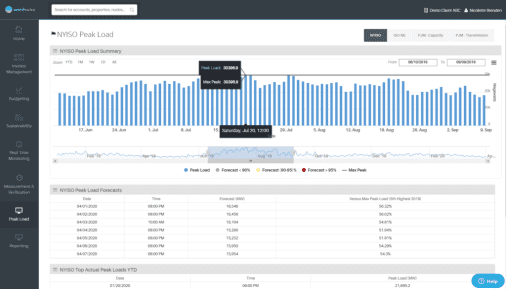
For most of us across the United States, summer weather still seems far away. From the perspective of a NYISO grid operator, the summer of 2019 was an interesting one and one they’ve been discussing for the past 6 months. For the first time, the overall system peak for the state occurred on the weekend, not on the typical weekday between 4-6 PM. With temperatures over 95 degrees Fahrenheit, the grid recorded its 2019 peak hour on Saturday, July 20, between 4-5 PM, at 30,397 MW. In contrast, the peak demand for 2018 was set on Wednesday, August 29th at 31,861 MW, which is much more typical.
So, what makes this weekend peak in 2019 so significant for 2020 electricity pricing? Capacity tags are determined by each account’s demand during the grid’s single highest peak hour. This demand is then translated into a capacity tag that is effective for the upcoming year from May 1 – April 30. Since the peak was on a Saturday, many commercial accounts within New York City were not running at full capacity during that hour.
After the weekend peak was established and set, with the uncertainty of never having a weekend peak before, we thought there were two potential scenarios that could happen:
- Nothing: The language in the tariffs were written in a way that any day, including weekends, can be considered a peak – due to that language, any deviation of the methodology would require legislative approval
- NYISO and/or the Public Utilities Commission would approve a new or updated version of the tariff and the ICAP calculation – changes could have been based on using a different weekday peak hour or scaling up the weekend peak values
About a week ago, the newest ICAP values for 2020/2021 were released, showing that ConEd and NYISO decided to use the weekend peak values to determine capacity tags. For NYC commercial real estate customers throughout the city, we’ve seen about a 30% reduction in tag values. Each building will be different depending on its activity during that 1 hour. Every 1000kW reduction in demand results in a capacity cost decrease of about $100,000. These credits will be seen starting on your May invoice if you are currently on a capacity adjustment product with your supplier.
ESCOs or third-party retail suppliers should all be using the new ICAP values for any contract starting May 1, 2020. For full fixed contract terms that go into May 1, 2021, that’s when the comparisons differ. We’ve seen some suppliers use the current ICAP values through the entire term of the contract, past April 30, 2021, and reserve the right to change the price once the 2021/2022 ICAP figures are known. Another way suppliers are pricing in future capacity costs is reverting back to 2019/2020 ICAP values for 2021 and beyond. We’ve even heard of suppliers not offering a full fixed product for the time being due to the capacity tag uncertainty and COVID-19.
To learn more about how you can manage and potentially reduce your capacity costs through peak load management and procurement strategy, request a demo today!


