
About 9 in 10 enterprises now use AI in at least one function. But most are only treating AI adoption as a way to get more efficient. They’re using chatbots, agents, and AI coding to save time and money. This approach only scratches the surface of what we can do with AI.
Increased speed is great, but adoption isn’t transformation. The real competitive advantage comes from rebuilding processes, roles, and technology from the ground up with AI at the center.
CRE decisions are built on specialized cross-functional expertise and workflows, not just data. So we need a new framework for approaching AI: a blueprint to empower every person, process, and technology with AI at the foundation.
As Tango’s Chief Technology Officer, I’m responsible for leading our teams through this transition, and I’ve spent 2026 implementing a framework to help transform our organization around AI. Internally, I began calling it “Tango 4.0” to describe the kind of company we needed to become, but the principles apply beyond Tango.
I call it the Ground-Up Framework. It’s about how we assess roles, processes, and technologies in relation to AI, and intentionally structure them with AI at the foundation.
Here’s how the Ground-Up Framework works, how we’re using it at Tango, and how your organization can join us on the journey to build a better way of working.
The Ground-Up Framework: a guide to transformation
I’m a technology guy. So this framework naturally started with the language of software versioning, progressing from 1.0 to 4.0. Numbered iterations are how I’ve thought about evolutions for my whole career.
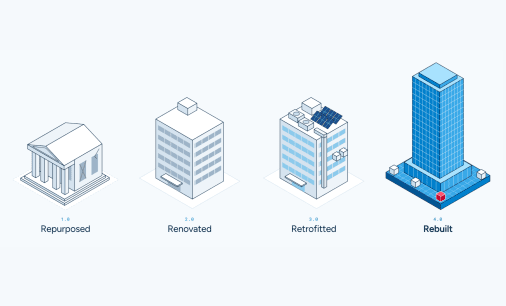
But this is real estate. We’re rebuilding structures on an AI foundation. So think of this framework as states of a building. Each state describes your organization in relation to AI: Repurposed, Renovated, Retrofitted, and Rebuilt from the ground-up.

At the “Repurposed” state, you’re not prepared to consider how AI should change your organizations. Your processes are held together with workarounds and duct tape, and your “technology” is basically spreadsheets and manual labor.
“Renovated” organizations have modern systems and follow pre-AI best practices. “Retrofitted” organizations embrace the traditional “adoption” mindset I described at the beginning. They add AI to speed up existing processes, but it’s still the same building. “Rebuilt” organizations redesign around outcomes, using AI as a foundation to construct better roles, processes, and technology.
You can’t transform without critically examining what was there before AI, and renovating and retrofitting won’t create meaningful new value. If you settle for these stages, competitors who rebuild around AI will pass you by.
That’s the idea. But for the progression system to work, you have to apply this framework to every function within your organization. What does each process, role, or tool look like at each stage? That’s how you understand what it takes to transform, and how each function needs to change.
Applying the framework
Let’s look at how the framework might apply to the product development process.
Repurposed
At the “Repurposed” stage, a product development team is making do with what they have. This might look like a unique, informal process for turning ideas into prototypes and working products—and it’s all barely functional. The tools and roles involved may not be consistent or optimized, but it gets the job done.
Renovated
At the second stage, the process consistently follows basic best practices. A product manager or business analyst writes product requirements documents (PRDs) and gives them to a designer. The designer then uses a tool like Figma to produce low-fidelity mockups and high-fidelity wireframes. After internal review and customer testing, they hand these off to engineers, who write the code. Testers check the code against the PRD to make sure it meets requirements.
Retrofitted
At this stage, the process is AI-enabled, and everything gets faster and more efficient. The product manager or business analyst writes their PRD with an AI copilot in JIRA as a single 500-word paragraph. Instead of giving it to the designer, the JIRA story gets ingested by Figma, and Figma’s AI, Figma Make, creates and codes the wireframe. Developers then take the wireframe and build the user interface, front end, and back end using AI to code faster.
It’s the same process, but AI accelerates the steps.
Rebuilt
In a rebuilt organization, this whole playbook gets turned upside down. There’s no PRD. No stories. All the requirements are being written into GitHub as a pull request using AI-generated code. Product managers can build prototypes themselves through prompts with Claude or Claude Design, and then test their ideas directly with customers. The linear process of PRD to wireframe to code and then a working app is completely disrupted. When it’s time to build the real thing, the engineer uses AI to code it.
The entire process can happen within Claude Code, so it skips the usual handoffs and moves exponentially faster because the process has transformed.
How we use The Ground-Up Framework at Tango
Rebuilding around AI is a process. You have to deconstruct each function, think about how it should work with AI, then create and implement a plan to get there. In my time at Tango, we’ve used the Ground-Up Framework as a roadmap to define how AI can transform every function in our organization. And that involves three key steps.
1. We reverse-engineer outcomes
Transformation starts with understanding purpose. What does each role, process, or technology need to accomplish? What’s it for? Instead of looking at our current org chart, tech stack, or workflow, we work our way backward from the desired outcome, and imagine the structure that would best achieve it.
Every function within Tango had its own outcomes, but one overarching outcome governed what transformation looked like. Our north star metric: annualized operating capacity unlocked. An improvement only counts if it names a core workflow, has a before and after number, and passes a spot check. We measure success by how much additional output any transformation creates.
Our pilot program began with rebuilding two functions: finance and engineering. As we learned what worked, their transformation became a template for the rest of the organization.
2. We empower every role to leverage AI
Employees can (and should!) have a voice in redesigning how they work. In fact, they’re often the best equipped to see opportunities for their role to transform.
We asked employees to combine their expertise with AI’s possibilities and help us build something better. We reimagined the career ladder to include specific AI competencies at every rung, and we use this new system to see how and where our people need to grow.
Part of this collaborative process included a use-case leaderboard: an internal dashboard that created a friendly competition for teams to see who could create the most AI use cases. Of course, we didn’t want to stop at measuring use case quantity—we needed a way to measure their quality too. So when it comes to testing and implementing them, “productivity per token” is the metric that matters. We reward engineers for using the right model for the job, applying skills as necessary, and optimizing prompts.
But in order for this to work, our people needed to get familiar with the AI tools we were encouraging them to innovate with. Everyone needed hands-on experience. We unlocked Claude for every employee and assembled five cohorts of AI learning circles. About one-third of Tango employees also completed formal AI training. And with that exposure, every employee became our resident expert on what a Rebuilt version of their role looks like.
3. We rework the division of labor between humans and AI
AI isn’t replacing our team. But it is changing what work looks like. AI takes over repetitive, manual, low-leverage work, and our people shift their focus to the tasks that require their judgment, relationships, insight, and creativity.
We want people to see AI as a tool that helps them work more effectively, not a threat to their job. So we’re collectively working to find the best combinations of human oversight and AI output.
Across the company, we are rolling out a “human + agent team” model. In finance, we now have an “Accounting Close Agent” working hand-in-hand with our accounting team. Closing our books at the end of the month used to take 20 days. Now it takes 7. In engineering, every engineer has several agents review their code. They can patch pull request bugs before an engineer finishes their morning coffee.
Finally, each function has graduation criteria: a clear finish line for crossing that Rebuilt, 4.0 threshold. When the roles involved can take full ownership over their new cadence and KPIs, it demonstrates that the function has completed the process of transforming around AI. Some functions have already finished, like product and engineering, while others are still working their way to graduation.
How real estate teams can use the Ground-Up Framework
The quickest, biggest Ground-Up win for CRE teams is in lease administration. Lease decisions are where most CRE functions begin, and they influence everything you do in some capacity. Plus, lease administration relies on gathering, summarizing, and interpreting mountains of data from different sources—the kind of work AI is great at. (Plus, we just released a new tool that does a lot of the heavy lifting here for you.)
You can self-assess your approach to lease decisions against the Ground-Up framework right now:
Repurposed
You’re here if your lease admin process looks like:
- Lots of disconnected spreadsheets and lease document folders
- Manually searching lease docs for data to abstract
- Manually keeping track of lease schedules
- Abstracting a single lease takes hours
The job gets done, but it’s been outdated for years, and the process is full of cracks where human error and lack of speed both create risk and limit potential.
Renovated
You’re here if your lease administration process looks like:
- Lease documents are centralized in purpose-built lease software
- Manual lease abstraction is faster because the data is more accessible
- Lease schedules are tracked in the system, but only reviewed periodically
- Condition-based lease options aren’t captured, and rarely make it into scenarios
Lease functions are more organized at this stage, but they have the same constraints, and still aren’t using AI.
Retrofitted
You’re here if your process looks like:
- AI-enabled lease software accelerates abstraction by retrieving data faster
- Humans still have to check every field and correct AI accuracy issues
- AI automates date tracking and creates alerts
- Humans still decide what alerts are urgent and who needs to know
AI-enabled processes get faster and more efficient, but otherwise, they look about the same as they did before AI.
Rebuilt
When lease administration is rebuilt from the ground-up, it looks like:
- Admins oversee teams of agents that are responsible for entire workflows
- Lease abstraction is fully automated: agents propose, people approve, and every value is linked to its source
- AI agents track critical dates and surface options to the right people at the right time
- Human experts stay in the loop to approve exceptions
- Admins reinvest their time in higher-value work, like building cost-saving scenarios
Here, AI has changed how lease processes work and what department roles look like, because everything has been redesigned around the best ways to achieve specific outcomes.
As you can imagine, rebuilding around AI isn’t easy. The trajectory is clear, but most CRE teams aren’t equipped to deconstruct legacy systems and redesign processes from scratch.
Good news: you don’t have to.
We just released Lease Intelligence, which provides the foundation teams need to rebuild their lease workflows. Tango’s agents handle lease abstraction, portfolio auditing, date tracking, and more—all while keeping your human experts in the loop.
And there’s more to come. Next year, we’ll have more agents to share, and more ways for you to rebuild CRE functions around AI.
Follow along with the journey to rebuild CRE from the ground up
At Tango, we’ve been building tools around machine learning and predictive analytics for two decades. Now, we’re reimagining what’s possible all over again with agentic AI, and accelerating real estate decisions at scale. We’re not just theorizing about how AI could transform CRE processes: we’re actively building this future on behalf of the teams we serve.
Building (and rebuilding) around AI is a core tenet of what we do at Tango. It’s how we work, and what we strive for as we create the real estate solutions of the future. I’ll be unpacking these ideas and sharing more about how we’re helping others become “Ground-Up” over on LinkedIn. Connect with me there to see where we’re headed.

