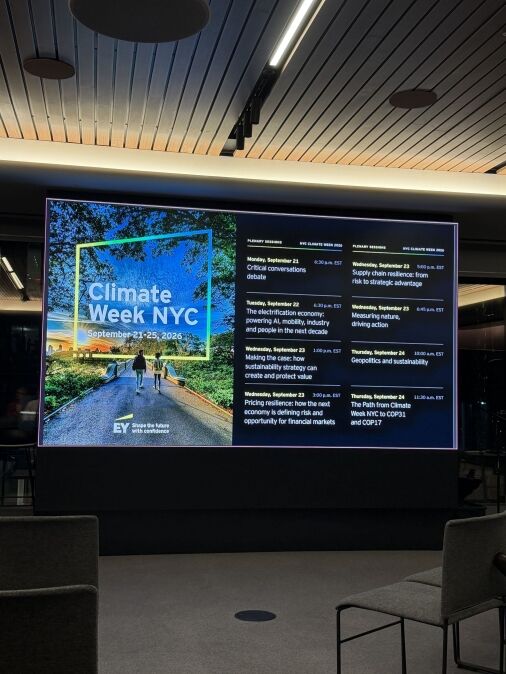

After attending Climate Week 2026, I am even more scared about the future.
EY-Parthenon’s “Four Futures” immersive, AI-visualized trip to 2055 put me in tears. It’s a big part of why I wanted to write this reflection.
But that wasn’t the only thing on my mind all week. Three topics kept coming up again and again: water scarcity, data centers and grid resilience, and regulations.
Here’s what Four Futures looked like, mapped across business-as-usual vs. radical shift, and best case vs. worst case:
- Best case if we make a radical shift (1.5°C): A future that still looks different from today, but is livable. Investments, product innovations, and clean technology made the difference. It’s the version of 2055 where the choices we made now actually paid off.
- Worst case if we make a radical shift (2°C): A future that’s deeply constrained. Climate change has already reshaped our lives, and governments have stepped in with restrictions on water, food, and consumption to keep things in order. We can all relate to this one, whether we want to or not, because we lived through COVID. I was living in Singapore at the time where we had restrictions on how many people we could meet, where we could go, etc. It wasn’t hypothetical for me. It was familiar.
- Best case if we continue business as usual (3°C): A future that’s degraded but still standing. People get sick more often. Climate events touch more of our lives, more often. It’s not collapse, it’s just worse, in every direction, all the time.
- Worst case if we continue business as usual (4°C): A future defined by famine, disaster, government collapse, and population decline. This is the scenario nobody wants to say out loud, but it’s on the table.

We know climate change is real. It’s not going to sneak up on us as a surprise the way a pandemic did. So why isn’t everyone working harder to prevent it? The simulation took us to the future, but coming back to the present wasn’t much more reassuring.
If you open your eyes, you’ll realize these four scenarios are already playing out in different pockets of the world today, just not yet at pandemic scale. We recently saw devastating, fatal floods in Nepal. Singapore’s air quality just hit an all-time low. The signs are already here; they’re just not evenly distributed yet.
The Four Futures experience was a jarring reminder of why we’re doing the work we’re doing – so let’s get into it, starting with water:
Topic 1: The War on Water
Someone at Climate Week said it plainly: “Water might be the next oil.” That line has stuck with me ever since.
We talk endlessly about carbon, but water scarcity is quietly becoming one of the most underpriced risks on corporate balance sheets. Unlike emissions, water is hyper-local. A company can have a strong global water strategy on paper and still be sitting on a facility in a basin that’s projected to run dry in a decade. As data centers, agriculture, and manufacturing all compete for the same shrinking supply in the same watersheds, the companies that haven’t mapped their water exposure are going to be caught flat-footed. This isn’t a future problem. It’s already showing up in permitting delays, rising utility costs, and community pushback in water-stressed regions today.
Topic 2: Data Centers, Grid Resilience, and Energy Affordability
This was inescapable all week. AI and data centers need power at a scale we haven’t seen before, and utilities are racing to expand grid capacity. Amongst this popular topic, a few things stood out to me:
Utilities used to plan for steady growth in electricity demand, but data centers are now requesting huge amounts of power and want it within a few years instead of the usual decade-plus timeline. That’s forcing two big shifts: utilities need better ways to prioritize the flood of connection requests they’re getting, and they need new pricing structures to make sure data center companies (not everyday households) pay for the infrastructure their demand requires — all while keeping the grid reliable for everyone else.
Unfortunately, we are already seeing data centers turning to stationary combustion, diesel, to fill power gaps in the short term. That’s a real problem because diesel generators burn fuel on-site with almost none of the pollution controls a power plant has, so they release more carbon emissions and harmful air pollutants right where people live and work, often in the communities closest to these facilities. The flip side is that this pressure on the grid is also accelerating renewable buildout: we’re generating more clean energy at the same time we’re leaning on more diesel, which is a strange and telling contradiction of this moment.
It’s also starting to change corporate real estate decisions. Companies are now factoring proximity to data centers into site selection, not because they want to be near one, but because they want to avoid it. Being close to a data center can mean more pressure on the local grid, higher electricity costs, and less reliable service. Grid strain is becoming a site-selection variable in a way it never used to be.
There was also an interesting thread about the US becoming a kind of learning ground for other regions. Europe, and France specifically, is just starting to grapple with data centers as a first step, and they’re realizing they need a real framework, not an ad hoc approach. Issues like affordability and land use that the US has been wrestling with for a couple of years are now landing on Europe’s desk, and they’re watching closely to see what worked and what didn’t.
Topic 3: Climate Policy and Regulation: A Deep Dive on Extended Producer Responsibility
For most of us in corporate sustainability, we’re fluent in the alphabet soup of sustainability reporting – IFRS, GRESB, CDP, SASB, and on and on. But running in a parallel, related-but-separate lane is the world of circular economy, waste, and Extended Producer Responsibility (EPR). Most teams are heads-down on carbon metrics, ratings, rankings, and Scope 3. EPR is its own domain, and it’s mostly about plastic.
I attended the SAP x Capgemini event on EPR, a policy model that shifts the cost of collecting, sorting, and recycling packaging onto the companies that put the product on the market, rather than leaving that burden with consumers or municipalities.
What struck me is that EPR sits in a genuinely different lane than emissions reporting – it’s fundamentally a product design and production question, not a data-and-disclosure one, so it makes sense that it lives with a different team. But the shape of the policy is one we’ve seen before. The conversations about preparing clean, auditable data for EPR compliance echo the conversations we’ve had about Scope 3 data. And the framing of EPR as a competitive advantage – not just a compliance cost, but a chance to differentiate through packaging and product design – is the same arc emissions reporting went through a few years ago, before it became a boardroom topic.
Where they diverge is maturity: emissions reporting regulations and building performance standards gained traction across US states and cities much faster than EPR has. My read is that EPR is still missing the synchronization emissions frameworks eventually converged on – compliance dates, reporting formats, and requirements are still all over the map state by state, which makes it harder to build one scalable process.
It’s a good reminder that climate policy is showing up in a lot of different shapes and forms right now – different owners, different mechanics, different timelines – but often rhyming with patterns we’ve already lived through once. As someone put it “climate policy never goes to sleep”.
While none of these three topics – water, grid strain, regulation – show up by name in the Four Futures scenarios, they are the mechanisms underneath them. The decisions being made right now on these topics are what will determine which version of 2055 we end up living in.
That’s what I felt compelled to share this. Climate Week didn’t leave me feeling less scared for the future, but it did leave me with a clearer sense of where the real work is happening, and where we need to keep focusing.


